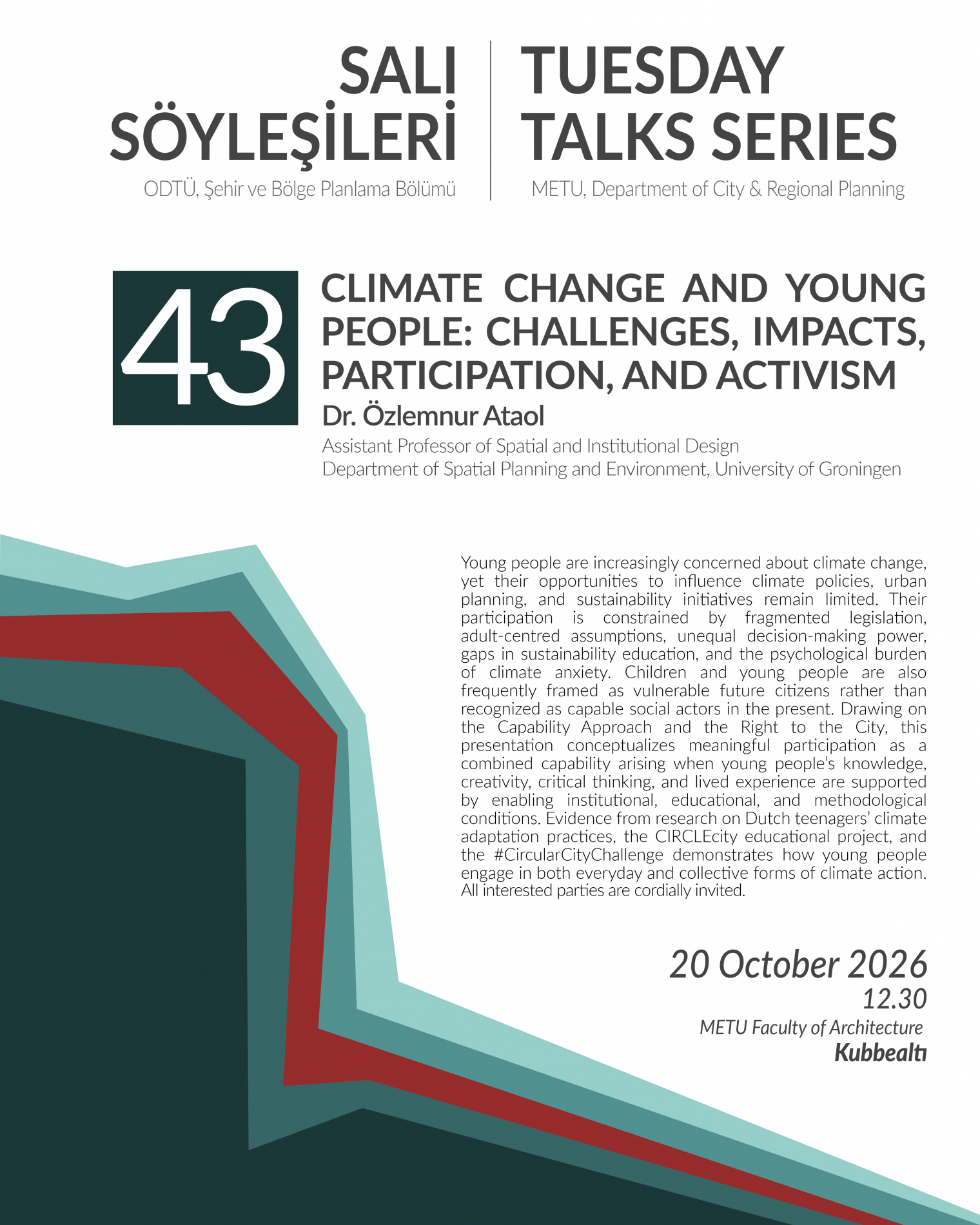
Tuesday Talks (43)
October 20, 2026 / Tuesday / 12.30
Faculty of Architecture, Kubbealtı, Middle East Technical University
Dr. Özlemnur Ataol
Climate Change and Young People: Challenges, Impacts, Participation, and Activism
Young people are increasingly concerned about climate change, yet their opportunities to influence climate policies, urban planning, and sustainability initiatives remain limited. Their participation is constrained by fragmented legislation, adult-centred assumptions, unequal decision-making power, gaps in sustainability education, and the psychological burden of climate anxiety. Children and young people are also frequently framed as vulnerable future citizens rather than recognized as capable social actors in the present. Drawing on the Capability Approach and the Right to the City, this presentation conceptualizes meaningful participation as a combined capability arising when young people's knowledge, creativity, critical thinking, and lived experience are supported by enabling institutional, educational, and methodological conditions. Evidence from research on Dutch teenagers' climate adaptation practices, the CIRCLEcity educational project, and the #CircularCityChallenge demonstrates how young people engage in both everyday and collective forms of climate action. All interested parties are cordially invited.
About the speaker
Dr. Özlemnur Ataol is Assistant Professor of Spatial and Institutional Design at the Department of Spatial Planning and Environment, University of Groningen. She is an urban planner, designer, and researcher specializing in participatory urban research and collaborative planning. Her work explores how participatory approaches can contribute to more inclusive, sustainable, and just urban development and governance. A central focus of her research is children's participation in urban planning and design. She approaches children as a distinctive and diverse group of urban users whose physical and mental well-being is profoundly shaped by the built environment from birth. Recognizing children as citizens of today as well as adults of tomorrow, she advocates for their right to participate in decisions they consider important, including those concerning their cities and everyday environments. Her research also examines the role of professional mediators, including researchers, architects, and urban planners, in creating accessible and meaningful participatory processes through which children can express their knowledge, needs, experiences, and aspirations and influence urban decision-making.