
PhD in City and Regional Planning
Last Updated:
Ph.D. in City and Regional Planning
For the Application Criteria of the PhD Program in City and Regional Planning, please click here.
Overview
Having initiated graduate education in 1961, the Department has offered the PhD degree in City and Regional Planning since 1977. The program prepares scholars to produce original, internationally recognized research that advances planning theory, methods, and practice. It develops doctoral candidates’ capacity to conceptualize complex socio-spatial problems, build rigorous research designs, and generate evidence that informs policy, plan-making, and spatial governance across scales—from neighborhoods and metropolitan regions to national and global systems.
Doctoral training emphasizes strong theoretical grounding and advanced methodological competence. Through seminars, collaborative research, and academic publishing, candidates cultivate a high-quality research culture, research ethics, and scholarly independence. The PhD is structured as a four-year program: during the first two years, students complete required and elective coursework aligned with their research interests. After coursework, students take the Proficiency Examination in City and Regional Planning; upon successful completion, they proceed to dissertation research and thesis writing under faculty supervision. The Department also offers an Integrated PhD track that can be pursued directly after the bachelor’s degree.
Curriculum
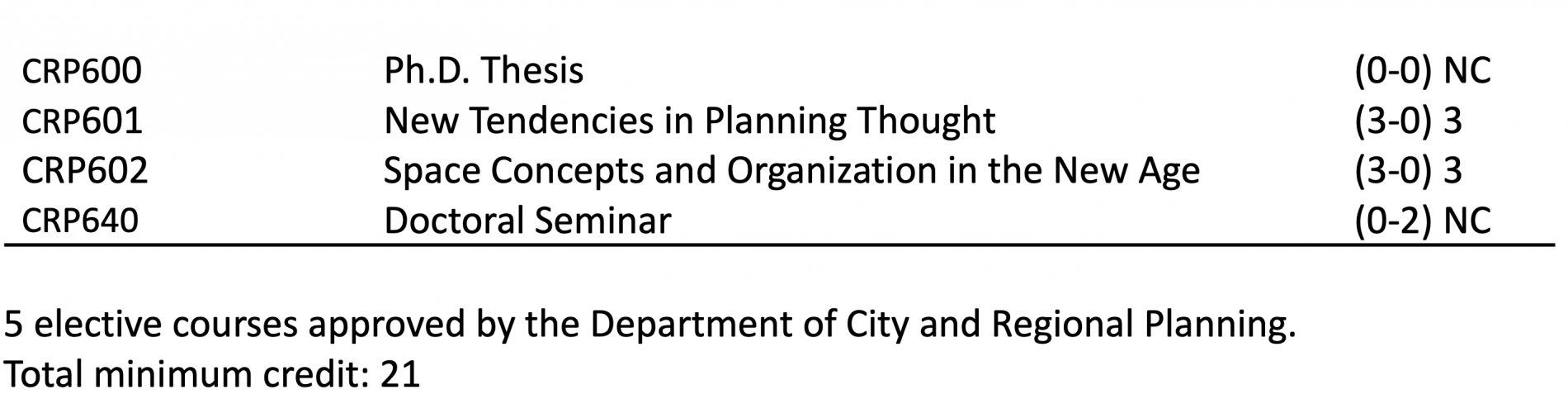
Integrated Ph.D. in City and Regional Planning
Curriculum
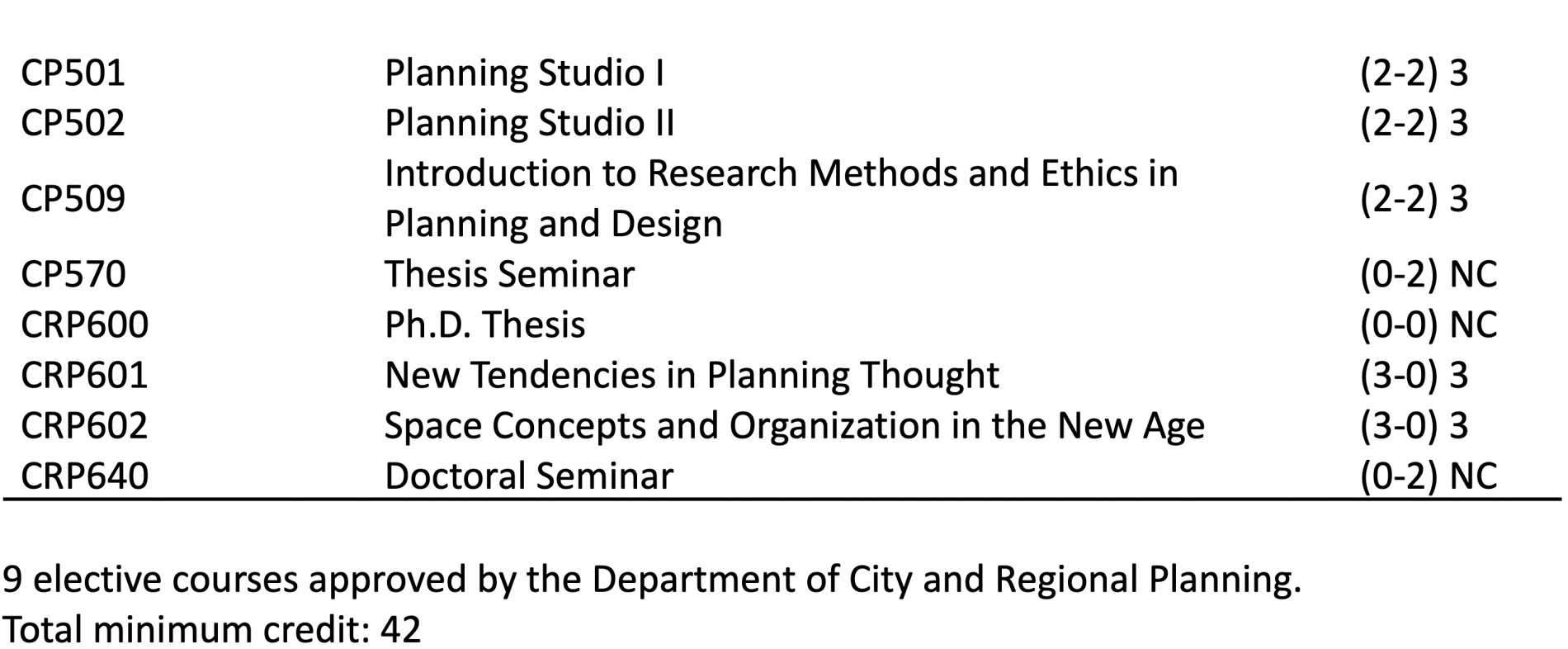
Course Descriptions
MUST COURSES
CRP601 New Tendencies in Planning Thought (3-0)3
The main objective of the course is to increase capacity of thinking in the theory of planning. Limits of predictabilities and instrumental rationality in planning. Critics of representative democracy. Human rights and citizenship. Civil society and governance. Emerging planning categories in the last two decades.
CRP602 Space Concepts and Organizatıon in the New Age (3-0)3
The objective of this course is to equip the students with the capacity of analysis of socio-spatial processes in urban, regional, and global context. Spatial foundations of social life, a socio-spatial epoch in the capitalist development, the emergence of networks and districts, new form of spatial organization and local economic development, regional problem in network society.
CRP640 Doctoral Seminar (0-0)NC
This course aims at helping doctoral candidates to develop scientific thinking capabilities and to improve academic writing and research design skills, regarding the discussions based on their specific theses with particular attention to a framework consisting of “aim, justification, context and methodology”.
ELECTIVE COURSES
CRP710 Planning, Action and Institutions: A Critical Analysis of Planning Theories (3-0)3
The goal is to create new planning sensibilities, enable students to criticize existing theories and planning practice and make them familiar to the new discourses on urban and regional planning. It also aims to promote thinking about what work planning theory should do, what its scope should be, and how theorising should proceed. The student is expected to acquire not only knowledge but a critical thinking on existing theoretical debates and gain insight into innovative thinking for the future of planning.
CRP711 Urban and Regional Development: A Critical Evaluation (3-0)3
This is an advanced course that will provide a critical analysis of existing urban and regional development theories and their practical implementation from the perspective of new challenges in urban and regional issues. The goal is to enable students to criticize existing theories and planning practice and make them familiar to the new discourses on urban and regional development issues.