
Master of City Planning
Last Updated:
Master of City Planning
To visit the website of the program, please click here.
Overview
The Master of City Planning is one of the Department's oldest graduate programs and complements the undergraduate curriculum with an emphasis on advanced, contemporary research. It supports specialization across key planning domains—such as housing, transportation, economic development, climate change, sustainability, resilience, urban development processes, and planning institutions—while strengthening graduates' skills as planners and decision makers.
The curriculum typically combines advanced theory and methods with applied studio and project work. Emphasis is placed on critical and creative thinking, ethical professional judgment, and research integrity, enabling students to produce robust analyses and policy proposals and, when appropriate, thesis-level research. The program is completed in four semesters.
The first year combines a studio-based environment with required and elective courses; the studio supports interrelated yet independent research projects focused on city planning agendas. After completing the first two semesters, students define a thesis topic and work under an advisor selected according to faculty specialization areas, completing the thesis in the final two semesters.
Curriculum
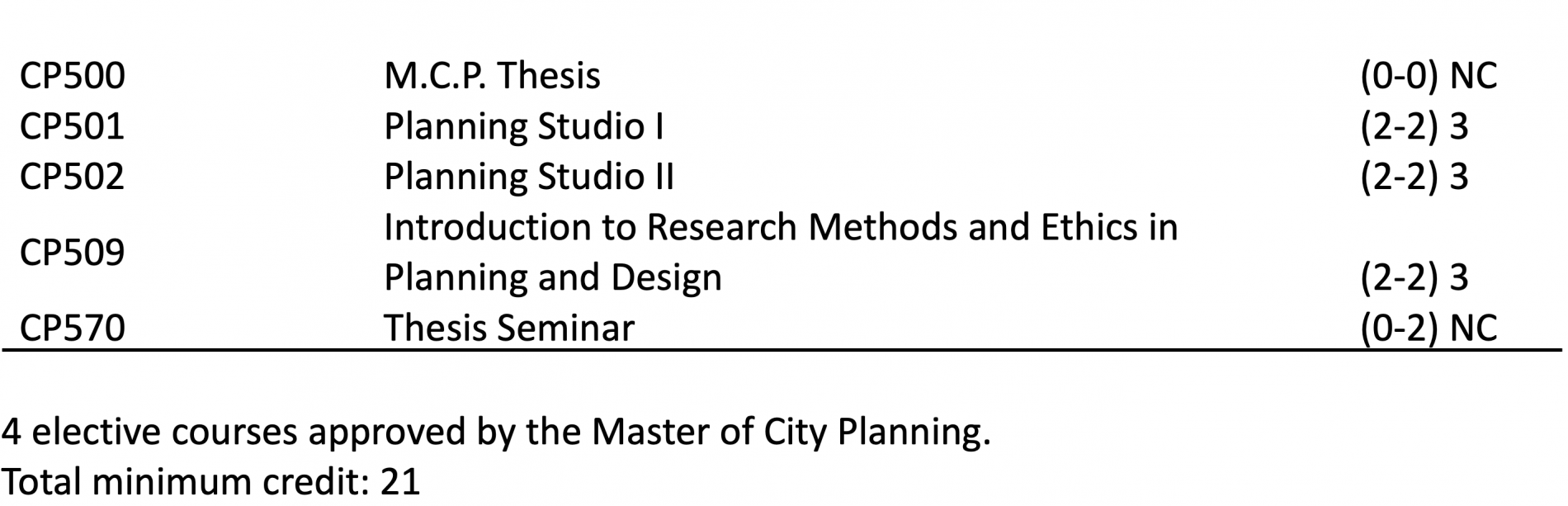
Course Descriptions
CP501 Planning Studio I (2-2)3
Planning Studio I explores the formation, use, and control of urban environments, emphasizing both theoretical foundations and practical applications. The course addresses contemporary urban problems through detailed surveys of techno-economic and socio-spatial phenomena, and students will develop policy prescriptions, spatial assignments, and design proposals. Impact and risk analyses, multi-dimensional assessments, and visual presentations are integrated throughout the course. The course integrates theory with hands-on studio work. Each week, students engage in lectures, workshops, and studio sessions focusing on spatial design, urban analysis, and the formulation of policy recommendations. Theory is drawn from seminal urban thinkers and is applied to case study projects. Fieldwork, group discussions, and collaborative projects enhance students' practical skills.
CP502 Planning Studio II (2-2)3
Planning Studio II is designed to develop students' ability to address site-specific urban planning challenges. This course complements Planning Studio I by shifting the focus from large-scale urban issues to localized interventions with an emphasis on nature based solutions and community resilience. Urban planning challenges include neighborhood redevelopment, public space improvement and community-based planning in the cities of Türkiye. Through analyses of best practices worldwide and hands-on studio work, students will engage in advanced design and policy proposals at the human scale, applying a main understanding of urban sustainability and resilience as well as participatory planning approaches. Lectures and discussions will provide theoretical and methodological foundations, while studio sessions will focus on applying the accumulation of knowledge to real-world sites in Türkiye.
CP509 Introduction to Research Methods and Ethics in Planning and Design (2-2)3
This course prepares students to conduct original research on topics related to planning and design. It introduces them to the research process design and different qualitative, quantitative and mixed-method research approaches used by planners and designers. It addresses the selection, development, application, and analysis of various types of methodological instruments and procedures for conducting research about the physical environment. It also introduces students to ethical issues in research.